Dewatering and Sediment Processing
Sevenson delivers comprehensive dewatering and water treatment services using innovative technology and proven expertise for complex environmental projects.
Sevenson delivers comprehensive dewatering and water treatment services using innovative technology and proven expertise for complex environmental projects.
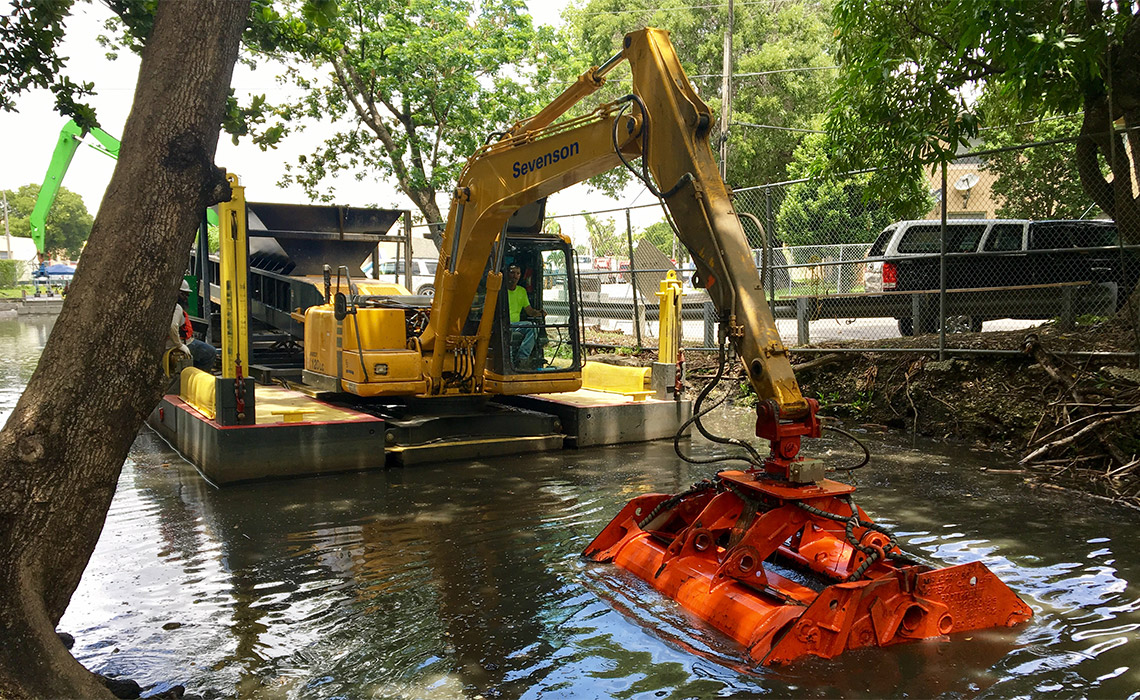
Sevenson dewaters sediments and materials from lakes, rivers, industrial ponds, pits, and lagoons, as well as waste streams generated by petroleum refineries, petrochemical plants, and wastewater treatment systems. The following equipment is used for dewatering operations:
Recessed-chamber presses have been used by Sevenson to dewater sediments/sludge from rivers, lakes, ponds, industrial basins, and process plants. To optimize liquid-solid separation, these units are generally upgraded by means of filter aids, such as lime, polymers, or diatomaceous earth. This practice shortens process cycle times and produces a low-moisture filter cake.
Belt presses are commonly implemented to dewater biological wastewater sludge from process treatment plants or biological wastewater settling ponds. Belt presses are particularly effective when processing sludge with high-moisture content.
Two-phase high-volume centrifuges are cost-effective technologies for large remediation projects requiring sludge dewatering. These units are normally operated at high-centrifugal g forces (2,000–3,000 g’s) and produce relatively dry filter cake and high-quality effluent. The advantage of using this technology is eliminating the need for bulking agents (polymer flocculent is typically added), resulting in reduced solids volume. Filter presses may require adding large volumes of filter aids, but centrifugation has no such requirement. This results in producing significantly less material as a final product.
Three-phase horizontal and vertical disc centrifuges (8,000–10,000 g’s) are used as process systems when specifications for oil and grease production are stringent (e.g., 0.5–1.0 percent bottom sediment and water). These units are widely used in the petroleum/petrochemical industries to process oily sludge, such as K048 waste streams or split-phase rag-layer emulsions, which can be produced by large dewatering operations.
Geotextile Tubes facilitate sediment dewatering through porous geotextile fabric. The dewatering process is typically aided by adding polymer to produce a filtrate that is clear. Based upon the results of sampling and analytical testing, filtrate can be either discharged to a designated location or transferred to the treatment plant for additional processing. Discharge options are specified in the project documents. Flow rates for geotextile tubes are usually 2,000 to 5,000 gpm depending on tube sizes and available laydown area.
Projects