Sediment Capping
Sevenson implements tailored sediment capping solutions, using advanced equipment and technology to safely place and stabilize materials while meeting project-specific and environmental requirements.
Sevenson implements tailored sediment capping solutions, using advanced equipment and technology to safely place and stabilize materials while meeting project-specific and environmental requirements.
Sevenson uses different sediment cover and capping methods depending on project regulatory requirements, specifications, project location, water depths, environmental factors, and materials needed.
Sevenson has capped thousands of acres of sediment.
Capping of sediments often follows an environmental dredging project, and the types of materials used include physical barriers such as sand, and treatment barriers such as granular activated carbon (GAC) and organoclays. Placement thicknesses are often specified in a range that is confirmed by hydrographic surveys or push cores. Sevenson’s capping equipment is typically configured with TMC and Dredgepack to ensure material placement is accurate. Capping methods include:
Mechanical Capping
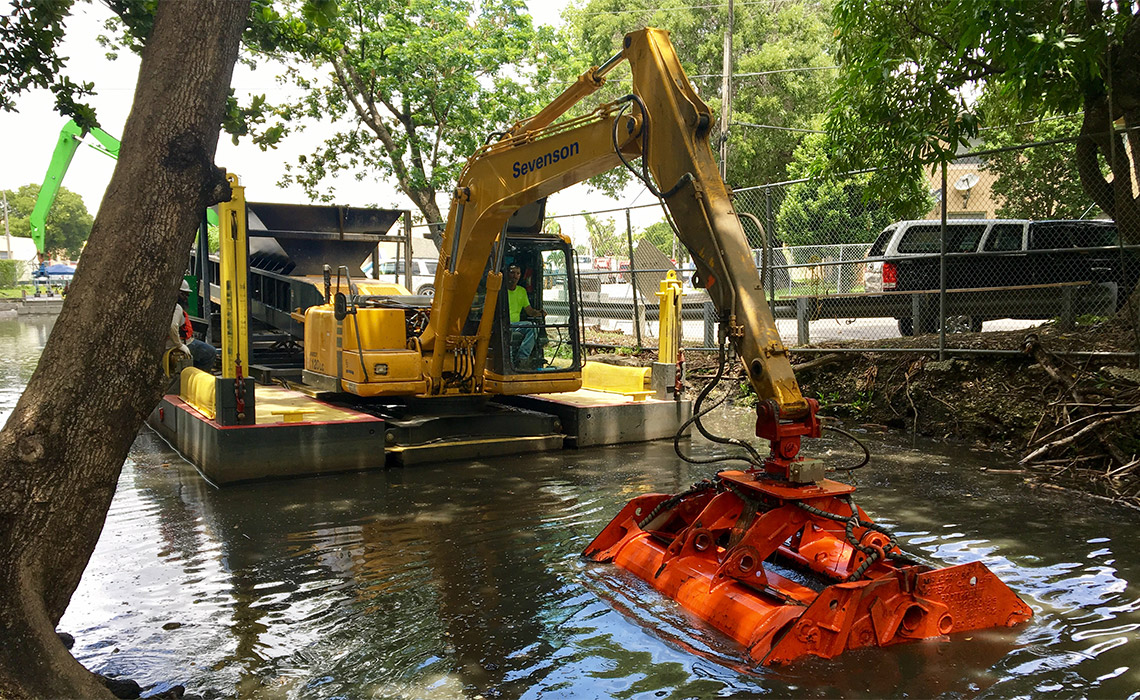
A hydraulic excavator stationed on a modular barge for placing sand and armor stone material. The clamshell bucket is slowly opened as the operator moves the bucket in an arc to gently place the cap material at the water surface or near the sediment/water interface. Production rates for mechanically placing material vary depending on material type/size, lift thickness, and water depth.
Hydraulic Capping
Sevenson developed and operates custom-built and patented slurry spreader systems for hydraulically placing cap material.
Materials are fed on a dry weight basis to a slurry hopper and mixed with makeup water. A dredge pump is used to convey the slurry. The hopper and slurry system are typically placed on the shoreline for easy mobilization and cap material delivery and loading. The slurry system can also be staged on a barge.
A diffuser/spreader barge is attached to the slurry system by a high-density polyethylene (HDPE) pipe. The barge has a discharge apparatus fabricated on the deck, which functions to dissipate the energy in the capping material slurry delivered to the placement barge. Cap material enters the water in a controlled fashion while the barge is moved at a controlled speed over a designated path with a cable winch system.
The barge’s controls are integrated with RTK DGPS and DREDGEPACK® positioning software. The RTK DGPS and the software is used to “drive” the barge along a preprogramed cap lane/path. The production rate of material placement is based on the pumping distance between the site and the shoreline, slurry flow rates, as well as the grain size of material.
Sevenson consistently demonstrates the ability to place cap lift thickness ranging from 1 inch to 18 inches per pass with the barge.
Radial Telebelt®
Sevenson developed a capping technology using a radial Telebelt® conveyor system. The system places various sizes of aggregates from fine-grain sand to six-inch diameter cobbles and is able to cover 15,000 SF per barge position. The barge is held in place using spuds while materials are transported to the capping barge via scows. An excavator offloads material from the scows and loads the Telebelt® feed hopper, which releases a set volume of material onto the radial stacker belt at a consistent feed rate. The Telebelt® swings on an arc using custom PLC automation integrated with the RTK DGPS system that tracks the conveyor’s boom tip. Feed rates can be adjusted to place designed lift thicknesses ranging from a few inches to several feet.
Among other advantages, the Telebelt® system works well when capping subtidal and intertidal areas, as its reach allows work to progress as tides fluctuate. Depending on site conditions, the Telebelt® placement method is an alternative to conventional mechanical placement.
Pneumatic Capping
Sevenson’s patented pneumatic capping system provides the controlled distribution of capping material and the capture of dust and particulates. They system includes an enclosure with a top wall and a continuous perimetrical side wall with an open bottom end. A cyclone inside the enclosure separates the air, dust, and particulates from solid materials. The air, dust, and particulates are exhausted from the enclosure to a filtering system. The solid capping material passes from the cyclone to a hopper and then to a spreader for the controlled distribution of the capping material through the open bottom end of the enclosure.
Projects